


Page 6 - hypertension_newsletter4_Final
P. 6
REFLECTIONS
                                                                                                                   Hypertension
     Hypertension Global Newsletter #4 2023


      Haemodynamic changes with arterial stiffness                                                                 Hypertension
      • Hyper-perfusion of high-flow organs causing microvascular damage
      • Elevated systolic pressure and subsequent diastolic dysfunction via concentric left ventricular remodelling and hypertrophy

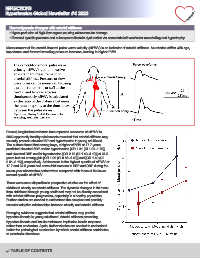
     Measurement of the carotid-femoral pulse wave velocity (cfPWV) is an indicator of arterial stiffness. As arteries stiffen with age,
     impedance and forward travelling pressure increase, leading to higher PWV.


     Recent, longitudinal evidence from repeated measures of cfPWV in
     3862 apparently healthy adolescents revealed that arterial stiffness may
     causally precede elevated BP and hypertension in young adulthood.
     The authors found that among boys, a higher cfPWV at 17.7 years
     predicted elevated SBP and/or hypertension [OR 1.31 (CI 1.02–1.70)]
     and elevated DBP and/or hypertension [OR 2.18 (CI 1.49–3.19)] at 24.5
     years but not among girls [OR 1.09 (CI 0.83–1.42)] and [OR 1.40 (CI
     0.91–2.16)], respectively. Adolescents in the highest quartile of cfPWV at
     17.7 and 24.5 years had a two-fold increase in SBP and DBP during the
     seven-year observation period when compared with those at the lower
     second quartile of cfPWV.

     There were some disparities in prospective studies on the effect of
     childhood obesity on arterial stiffness. The dynamic changes in fat mass
     from childhood through young adulthood may not be directly associated
     with arterial stiffness progression, especially in a healthy population.
     Further studies are needed to understand the complex and possibly
     vascular adaptive relationships between obesity and arterial stiffness.

     Emerging evidence suggests that arterial stiffness may predict
     hyperinsulinemia in young adulthood. Arterial stiffness preceding
     hyperinsulinemia and insulin resistance implicates insulin response
     rather than production. Again, further studies are needed to understand
     better the pathological mechanism by which arterial stiffness contributes
     to metabolic alterations.


          TABLE OF CONTENTS

