


Page 13 - hypertension_newsletter4_Final
P. 13
REFLECTIONS
                                                                                                                   Hypertension
     Hypertension Global Newsletter #4 2023


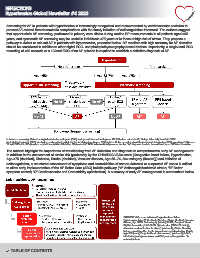
     Screening for AF in patients with hypertension is increasingly recognized and recommended by cardiovascular societies to
     prevent AF-related thromboembolic complications with the timely initiation of anticoagulation treatment. The authors suggest
     that opportunistic AF screening, performed in primary care clinics during routine BP measurements in all patients aged ≥65
                                                                                                                   Hypertension
     years, and systematic AF screening may be useful in individuals ≥75 years or in those at high risk of stroke. They propose a
     pathway to detect or rule out AF in patients with hypertension, presented below. BP monitors with high accuracy for AF detection
     should be considered in addition to other digital ECG- and photoplethysmography-based devices. Importantly, a single-lead ECG
     recording of ≥30 seconds or a 12-lead ECG of an AF episode is required to establish a definitive diagnosis of AF.


     In in-person screening, 12-lead or single-lead electrocardiogram (ECG) tracing could be used to diagnose AF. If this does not show AF, 14 days twice-daily handheld ECG/
     photoplethysmography (PPG) monitoring or alternatively, a 5–7 day (up to 14 days) continuous ECG patch or Holter recording should be performed. A single-lead ECG recording of ≥30 s or a
     12-lead ECG of an AF episode is required to establish a definitive diagnosis of AF. BPM indicates blood pressure monitor. *AF diagnosis needs to be confirmed by an ECG documentation.
     The authors highlight the importance of transitioning from AF detection and diagnosis to comprehensive early AF management.
     In addition to the assessment of stroke risk (preferably by the CHA2DS2-VASc score [Congestive heart failure, Hypertension,
     Age ≥75 (doubled), Diabetes, Stroke (doubled), Vascular disease, Age 65–74, Sex category (female)]) and initiation of
     anticoagulation, a structured assessment of symptoms and comorbidities of screen-detected or suspected AF cases is critical
     to allow early implementation of the AF Better Care (ABC) holistic pathway (“A” Anticoagulation/Avoid stroke; “B” Better
     symptom control; “C” Cardiovascular and Comorbidity optimization). A summary of early AF management is summarized below.


                                                                             CHA2DS2-VASc score indicates Congestive heart failure,
                                                                             Hypertension, Age ≥75 (doubled), Diabetes, Stroke (doubled), Vascular
                                                                             disease, Age 65-74, Sex category (female); EHRA, European Heart
                                                                             Rhythm Association; HAS-BLED, Hypertension (SBP>160 mmHg),
                                                                             Abnormal renal and/or liver function (1 point each), Stroke, Bleeding
                                                                             history or predisposition, Labile international normalized ratios, Elderly
                                                                             (age >65 years), Drugs and/or alcohol excess (1 point each); LAAO,
                                                                             left atrial appendage occlusion; and OAC, oral anticoagulation. *In
                                                                             selected patients.


          TABLE OF CONTENTS

